Skills shortage in the industrial lab – how a LIMS provides relief
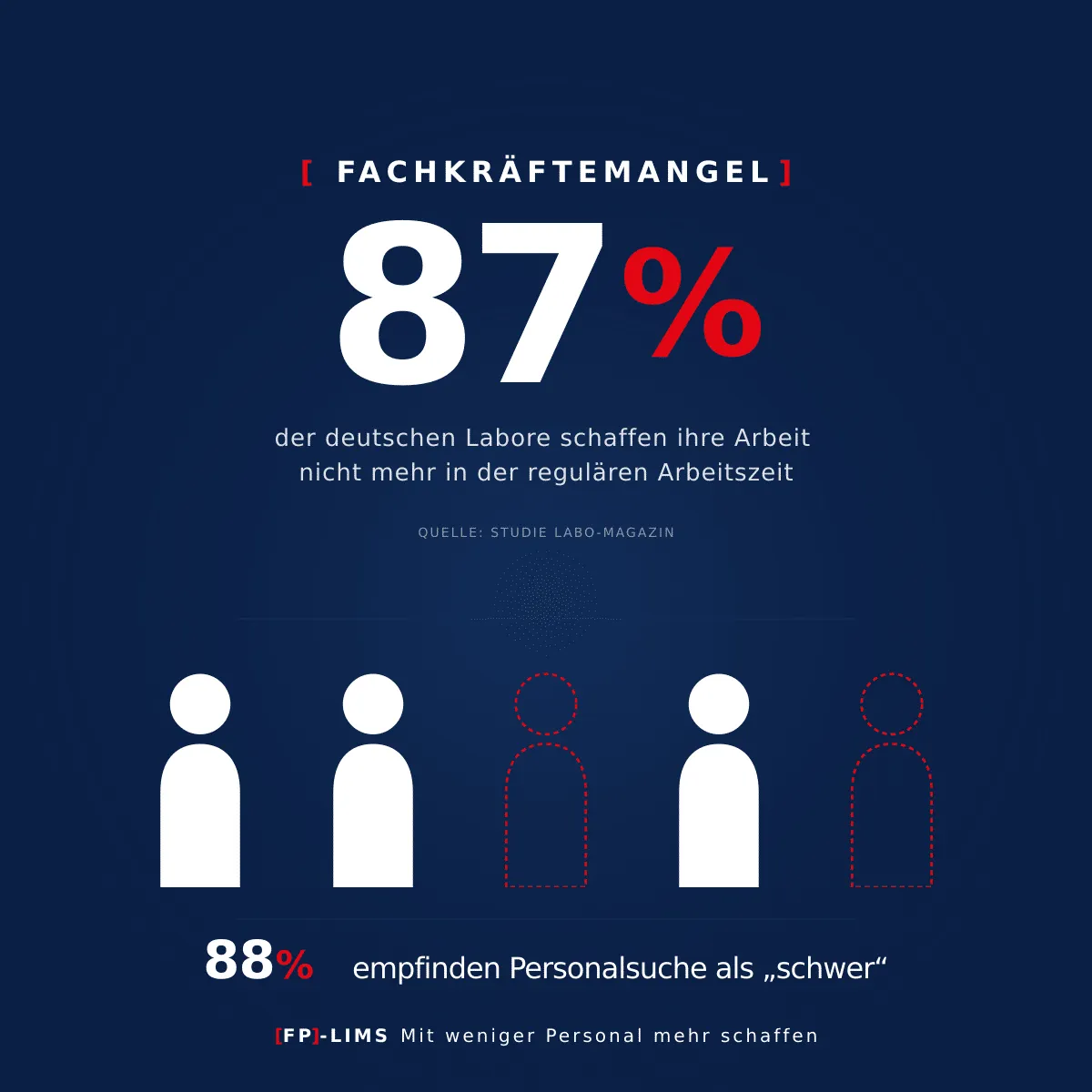
87 % of German labs can no longer complete their work within regular hours. 88 % describe the search for personnel as “difficult” to “very difficult”. The pattern is similar across most industrialized economies. When you can’t fill open positions, you have to relieve the team you already have – through automation, less documentation overhead, and faster onboarding. How a LIMS becomes the strategic answer, and why [FP]-LIMS in particular fits this picture.
The skills shortage in industrial labs describes the widening gap between open positions for lab professionals (lab technicians, chemists, materials testers) and qualified applicants. The drivers: demographic shift, a rising share of young people choosing university over vocational training, and increasing technical demands from digitalization. The consequence: fewer people handle more work – usually under regulatory pressure (ISO 9001, ISO/IEC 17025). A LIMS becomes a strategic source of relief here, because it automates routine and secures knowledge.
The numbers are alarming
The skills shortage has long ceased to be just a trades problem. Industrial labs are massively affected too. The worries of lab managers and executives grow with every unfilled position. A survey by LABO Magazine (Germany) provides clear numbers:
can no longer complete their work within regular hours – simply because they’re short of staff.
as “difficult” to “very difficult”. Open positions stay empty for months, sometimes more than a year.
Overtime, temps, deferred maintenance and documentation – the invisible costs of the staffing gap.
While the figures above are from a German survey, the pattern is recognizable across most industrialized economies in Europe and North America. What these numbers mean day-to-day is clear to every lab manager: shifts get tighter, routines suffer, quality comes under pressure – and when someone calls in sick, the plan collapses entirely. You can’t conjure up personnel – but you can reduce the workload.
Why the gap keeps widening
Three structural causes work together – none of them solvable overnight:
- Demographic shift – the baby-boomer generation is retiring; the cohorts following are numerically smaller. This effect is irreversible and will become more pronounced over the next 10 years.
- Higher university enrollment – many young people choose the academic path over vocational training as lab technicians, materials testers, or analytical chemists. The result: classic industrial lab professions have fewer trainees coming in.
- Rising technical demands – modern labs work with digital workflows, ISO accreditations, and complex instruments. Anyone who masters this is in high demand – and can switch employer at will.
So what options does a lab have to handle the workload despite a skills shortage? A fast, future-proof answer is a Laboratory Information Management System (LIMS) – not as a replacement for people, but as an amplifier for the team you already have.
Where the skills shortage hurts most in the lab
In which areas does the industrial lab feel the personnel gap first? From over 30 years of practice at Fink & Partner, we keep seeing the same three pain points:
Routine & documentation
Transcribing data, filing reports, assembling summaries – this often eats up 30–40 % of lab time. This is exactly where automation is easiest to deploy.
Shift operation & handovers
In 3-shift operation, every handover takes time and knowledge. If one shift is short-staffed, both handover quality and process reliability suffer.
Knowledge loss on departure
When an experienced colleague leaves, decades of experience often walk out with them. What they knew instinctively has to be documented from scratch – if anyone has time to do it.
5 levers a LIMS provides to relieve the team
A well-deployed LIMS addresses exactly these pain points. With [FP]-LIMS, we work on five concrete levers:
- Automating routine Data flows directly from the spectrometer, hardness tester, or titrator into the LIMS – no transcribing. Standard test reports are generated at the push of a button. This typically saves 1–2 hours per employee per day.
- Preserving knowledge & method standards Test methods are stored centrally and versioned. When a colleague leaves, their “how-to” knowledge stays in the system – not just in their head.
- Faster onboarding for new staff Guided workflows make it easier for new staff to get up to speed. Instead of struggling through for months, they’re productive within days. Temps, interns, and working students can do clean work too.
- Self-service for production and customers With the browser interface, machine operators and production managers see live data directly on the shop floor – without calling the lab. That relieves lab staff from constant query interruptions.
- Shift flexibility Thanks to central data storage and an automatic audit trail, every shift can pick up exactly where the previous one left off – without long handover briefings. Even short-notice staff changes become manageable.
Time savings concretely – where the day gets longer
What do these five levers mean in concrete hours? This comparison shows typical tasks from industrial-lab day-to-day – with and without a LIMS:
| Task | Manual / spreadsheet | With [FP]-LIMS |
|---|---|---|
| Capture measurement data (50 samples) | 2 hours | 15 minutes |
| Generate daily report | 60 minutes | 2 clicks |
| Answer auditor questions | 2–3 hours | Immediately |
| Shift handover | 20–30 minutes | 5 minutes |
| Onboard new method | Days of self-study | A few hours, guided |
| Statistics & SPC analysis | Half a day per week | Live dashboard |
Projected onto one employee per month, this quickly adds up to 20–40 hours of relief – time freed up for more demanding tasks. Or, simply: time that doesn’t end up as unpaid overtime.
Get started fast – even on a small budget
One of the most common concerns: “A LIMS is a big project – we can’t take that on right now.” Only half true. With the [FP]-LIMS Light Edition there’s an affordable entry-level variant that fits into the existing workflow immediately, without you having to redesign your day-to-day.
- Light Edition – for single-user labs with one instrument, as an affordable entry point
- Standard Edition – the multi-user variant with all core functions
- Professional Edition – for group labs with complex requirements, multiple sites, and ERP integration
If you start with Light, you can upgrade to Standard or Professional later – without a system change. The entry stays small, you can verify the impact, and then expand exactly where it hurts.
Practice: stabilizing shift operations – even with staffing gaps
How the LIMS effect plays out in a real industrial lab is best seen through long-term customer practice. A German precious-metals refinery with around 25 employees in chemical labs runs 3-shift operations, accredited to ISO/IEC 17025. [FP]-LIMS has been the central tool for analytical data management there since 2012.
What does this mean in practice? Even when a shift is thinner than planned, data remains consistent, the audit trail stays complete, and handover to the next shift runs smoothly. The LIMS is the stable foundation that carries the shift system – even when personnel availability becomes volatile.
Similar picture at a European market leader for passenger-car brake discs:
“I cannot imagine how our production would function without the LIMS.”
European market leader for passenger-car brake discs
In highly automated production environments, the LIMS has long stopped being a “nice-to-have”. It’s the system without which shifts and production wouldn’t run stably anymore – whatever the current staffing situation looks like.
Frequently asked questions about the skills shortage in the lab
Does a LIMS replace staff?
No. A LIMS is not a replacement for people, but a tool that allows the team you have to achieve more – without overtime and without losing quality. Routine is automated, knowledge is preserved, onboarding accelerated. That frees up space for the demanding tasks that genuinely require people.
How much time can be saved concretely?
Practice numbers from industrial labs: 20–40 hours of relief per employee per month. The strongest levers: automatic instrument data import (instead of transcribing), automated reports (instead of spreadsheet wrangling), and faster audit preparation.
What is the [FP]-LIMS Light Edition?
An affordable entry-level variant for single-user labs with one instrument. Immediately deployable, without redesigning the workflow. Anyone who grows or needs more functionality upgrades later to Standard or Professional – without a system change.
Does a LIMS help with onboarding new staff?
Yes. Guided workflows, stored test methods, and plausibility checks dramatically reduce error sources for newcomers. New employees are often productive within a few days – instead of weeks or months of onboarding. Temps and working students can also do clean work.
How long does a LIMS implementation take?
From contract signing to productive use typically takes 2 to 6 months – depending on size, number of integrated instruments, and sites. With [FP]-LIMS, first users are often productive within a few days. The Light Edition can be rolled out even faster.
What happens to the knowledge of long-serving employees?
In the LIMS, methods, tolerance bands, evaluation rules, and inspection steps are stored centrally. When an experienced colleague leaves, their approach stays documented in the system – not only in their head. This is one of the most important arguments for a LIMS in aging workforces.
Does a LIMS pay off for small labs too?
Yes – especially there. Small labs are particularly vulnerable to staffing gaps: when one person is out, 30–50 % of capacity can disappear overnight. A LIMS prevents this risk from becoming existential, because routine is automated and knowledge is secured.
What if the budget is tight?
Start with the [FP]-LIMS Light Edition. It’s designed as an affordable entry point. After successful introduction, you can add functions and modules as needed. Payback typically happens within 12–24 months through saved working hours.
Achieve more with less personnel – we’ll show you how
In a 30-minute live demo we’ll show you concretely how [FP]-LIMS automates routine, secures knowledge, and gets new staff productive faster.